

Understanding Binary Trees: Basics and Uses
🌳 Understand binary trees: their structure, types, and common operations like traversal, insertion, and deletion. Learn practical uses with clear, South African-friendly explanations.
Edited By
Isabella Hughes
Binary star systems consist of two stars gravitationally bound and orbiting a shared centre of mass. Unlike solitary stars such as our Sun, these paired stars offer astronomers a natural laboratory for understanding stellar physics and the wider mechanics of the cosmos.
Why do binary stars matter? Their importance lies in how they help measure stellar masses directly—a challenging task for single stars. Accurate mass data is essential; it influences how a star evolves, the nuclear reactions at its core, and even the type of remnant it leaves behind.
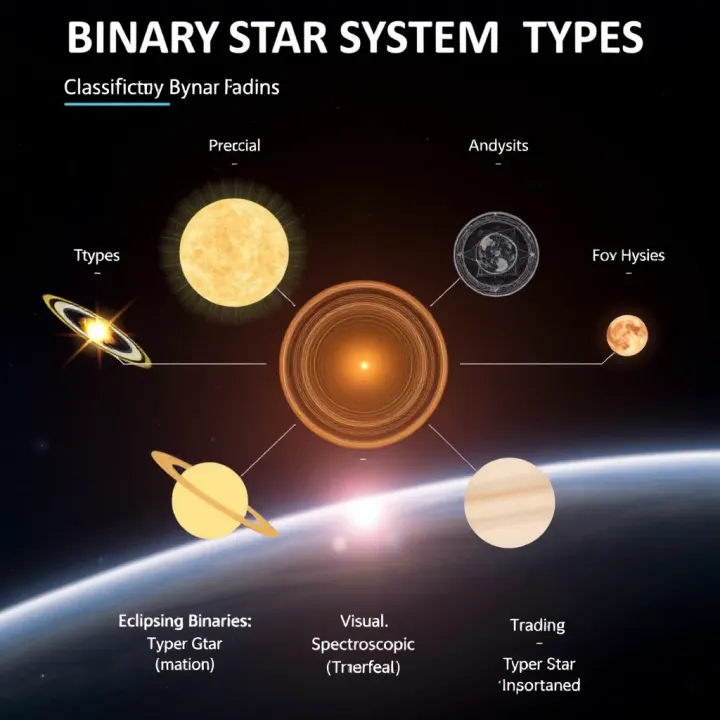
Binary stars serve as key benchmarks for calibrating models of star formation and stellar evolution.
The structure of binary systems varies widely:
Detached binaries: Both stars retain their individual atmospheres without interference.
Semidetached binaries: One star fills its Roche lobe and transfers material to its companion.
Contact binaries: Both stars share a common envelope of gas.
Observing these configurations informs us about mass exchange and angular momentum loss, events pivotal to interpreting phenomena such as novae or the formation of exotic objects like neutron stars.
Visual binaries: Resolved through telescopes as distinct points of light.
Spectroscopic binaries: Identified by the Doppler shifts in their combined light spectra.
Eclipsing binaries: Detected by changes in brightness as one star passes in front of the other.
These varied observation methods highlight the system’s orientation and distance, affecting how we interpret their data.
For those following cosmic developments or investing in space-related technologies, grasping binary systems enriches understanding of astrophysical processes that influence everything from cosmic distance measurements to the lifecycle of galaxies.
In short, binary stars are far from just curious oddities; they play a vital role in decoding the universe’s past, present, and future. From gravitational waves detected by observatories like LIGO to refining the cosmic distance ladder, their significance touches both pure science and applied astrophysics.
Understanding what binary star systems are is fundamental to grasping the broader discussion of how stars interact and evolve. These systems consist of two stars that share a common centre of mass, orbiting each other under mutual gravitational pull. Recognising this helps investors and analysts appreciate the significance of observations used in stellar astrophysics, which often impact technological advancements and research funding.
Basic concept: A binary star system is simply two stars locked in orbit around a shared point — their centre of mass, also known as the barycentre. Unlike single stars like our Sun, these pairs influence each other’s behaviour, brightness, and life cycles. Understanding this dual dynamic aids astronomers in measuring stellar parameters such as mass and radius, offering more reliable data than what single stars can provide.
How stars orbit each other: The orbit between two stars varies depending on their masses and distance apart. Often, one star is heavier, causing it to move slower while the lighter star swings more swiftly in an elliptical or circular path. The balance of gravitational forces keeps them locked in a cosmic dance. This orbital motion creates observable effects, like changes in light or spectral lines, which astronomers track to determine critical properties like mass ratios — information vital for modelling star evolution or predicting phenomena such as supernovae.
Prevalence among stars: Binary star systems are surprisingly common. In the Milky Way, roughly half of all stars belong to some form of binary or multiple-star system. Bright, massive stars almost always appear in pairs or groups. This prevalence matters because it shapes how we understand star formation and distribution across galaxies.
Comparison with single star systems: While single stars like the Sun do exist, they are somewhat the exception rather than the rule. Single stars often form from disrupted binary or multiple systems or as isolated collapses. The difference matters to astronomers trying to map the lifecycle of stars since binary interactions — such as mass transfer or gravitational effects — significantly impact their development and end states. For practical purposes, recognising whether a star is part of a binary system helps refine distance measurements and astrophysical models that hold value for academic institutions and industries relying on space research.
Knowing how binary stars orbit and how widespread they are provides essential context for their study and the technologies built to observe them.
Binary star systems come in various types, each offering unique ways to study stellar characteristics and behaviour. Understanding these types helps astronomers determine mass, size, and dynamics of stars that would otherwise remain hidden. For investors and analysts looking at space-related technologies or satellite data firms, recognising these differences adds depth when evaluating astronomical research impacts.
Visual binaries are systems where both stars can be seen distinctly through telescopes. Their defining feature is simplicity in observation—they can be individually tracked across their orbital paths. This makes them ideal for direct measurement of orbital parameters such as distance between stars and period of orbit.
Such binaries are often used as benchmarks in astrophysical calculations because their apparent positions give immediate clues about the orbit. For example, the star system Alpha Centauri is a well-known visual binary visible even with modest telescopes, making it a favourite for amateur and professional astronomers alike.
Spectroscopic binaries reveal their presence through shifts in spectral lines caused by Doppler effects. Even if the two stars can’t be resolved visually, shifts in light frequency indicate motion towards or away from Earth. This method unveils binaries too close to be distinguished by imaging.
This is especially useful for studying distant or tight pairs where visual resolution falls short. A practical example is Sirius, whose companion white dwarf was confirmed through such spectral analysis. These insights are vital for understanding star mass and velocity, crucial for modelling the life cycles of stars.

Eclipsing binaries display changes in brightness as one star passes in front of the other. These variations create light curves—graphs showing brightness over time—that help astronomers determine orbital inclination and period with high precision.
Beyond orbits, light curves allow measurement of star sizes and surface features. For instance, the famous binary Algol exhibits predictable dips in brightness, revealing detailed information about the components' size and structure.
Astrometric binaries are detected by observing a wobble in the visible star’s position, signalling an unseen companion. This subtle movement requires precise instruments, often achievable with modern space telescopes. Such data assist in finding exoplanets or faint stars otherwise invisible.
Close binaries or contact binaries share stellar material or have tidally distorted shapes due to proximity. Their behaviour includes mass transfer and sometimes explosive events like novae. Understanding these systems informs knowledge of stellar evolution and the ultimate fates of stars.
Knowing the type of binary star system you’re dealing with shapes the kind of data you collect and what you can infer about the stars' properties and life stages.
Each binary type unlocks a different window into the cosmos. Whether by direct imaging, spectral analysis, brightness timing, or positional wobble, these methods form a toolkit for astronomers exploring the stellar neighbourhood and beyond.
Binary stars don’t just pop into existence side by side; their formation and evolution are tied deeply to the physics of star birth and interaction. Understanding these processes helps clarify why binaries appear so frequently and why their behaviour can be quite different from single stars. This insight can shed light on stellar lifecycles, which in turn informs models used by researchers and practitioners observing or simulating star populations.
Stars form in dense clouds of gas and dust known as molecular clouds. These cold, dark regions collapse under gravity, eventually creating protostars. In many cases, turbulence or uneven density causes the cloud to break into several dense knots. Instead of a lone star emerging, multiple stars can form in proximity, setting the stage for binary systems. This scenario is quite common; estimates suggest over half of stars form in multiples.
This process has practical implications. For instance, when astronomers study star-forming regions like the Orion Nebula, they often find young pairs or multiples. Observing these early systems helps improve predictions on the type and frequency of binaries in the broader galaxy.
The fragmentation of a collapsing cloud is a key mechanism for binary formation. Essentially, a large molecular cloud fragments into smaller collapsing cores, each destined to become a star. If two cores form close enough, their mutual gravity locks them into orbit around a common centre of mass. The distance and mass ratio then establish what kind of binary will result — wide, close, nearly equal-sized or unequal pairs.
From a practical perspective, this understanding guides astronomers in simulations and observations. For example, studying how fragmentation varies with cloud mass and temperature helps anticipate whether a region yields more wide binaries or tight pairs. These differences influence how star clusters evolve over millions of years.
A fascinating feature among binaries is mass transfer. When one star in a close pair expands — often during its giant phase — its outer layers can spill over onto the companion through a shared gravitational boundary called the Roche lobe. This exchange alters both stars significantly, affecting brightness, temperature, and evolution paths.
This phenomenon is important not just theoretically but also observationally. X-ray binaries, where a neutron star or black hole siphons matter from a companion, are some of the brightest X-ray sources seen. Understanding mass transfer clarifies how such exotic systems emit energy and evolve.
The interplay between paired stars shapes their ultimate destiny. Mass gain or loss can accelerate or delay nuclear burning in either star. Some binaries end with one star exploding as a supernova, potentially disturbing or destroying the companion. Others may evolve into compact pairs of white dwarfs, neutron stars, or black holes.
For practical astronomy, this knowledge is crucial. It helps explain observed populations of stellar remnants and predicts phenomena such as gravitational wave events. These are mergers of compact binaries, detected by instruments like LIGO and Virgo, providing windows into extreme physics.
Binary stars give astronomers natural laboratories to test stellar physics under conditions hard to replicate in isolation. Tracking their formation and evolution enriches our grasp of the universe's workings.
This solid grounding in formation and life cycle sets the stage for appreciating why binary stars are more than just common—they're key to understanding the cosmos.
Binary star systems provide a unique window into the workings of stars and the universe at large. For traders and analysts interested in the broader picture of science and technology, understanding their importance sheds light on how we measure cosmic distances and test fundamental physics. These systems offer practical tools that help refine models used in astrophysics, which in turn influence fields like satellite technology and space exploration.
Binary stars orbit a common centre of mass, governed by Newton's laws of motion and gravitation. By observing the orbital period and distance between the two stars, astronomers can directly calculate the masses of each star using Kepler’s Third Law. This is crucial because it provides one of the few reliable ways to measure stellar mass outside our solar system. For example, the Sirius system—one of the brightest stars in the night sky—is a well-studied binary whose orbital motions have provided accurate mass estimates for both components.
Since mass determines a star’s life cycle and brightness, binary systems serve as benchmarks for calibrating other measurements like luminosity and radius. Accurate mass data from binaries allow astronomers to anchor distance calculations made through parallax or standard candles. This benchmarking is vital when estimating distances to far-off galaxies or when determining star populations within the Milky Way. Accurate distance measures directly impact technologies reliant on precise positioning, including GPS satellites and space navigation.
In many binary systems, one star can transfer matter to its companion, profoundly altering their evolutionary paths. This mass exchange can cause phenomena like novae or even type Ia supernovae, which are key distance markers in cosmology. Observing these effects helps scientists understand how stars live and die differently when paired. For investors interested in space technologies, this knowledge underpins efforts in forecasting stellar events and their potential impacts on space weather and satellite operations.
Binary stars challenge and refine our models for lone stars. Many stellar evolution theories were built assuming stars evolve in isolation, but binaries reveal complications like tidal forces and mass transfer. Comparing data from binaries against single star models reveals discrepancies that drive improvements in these theories. This sharpened understanding is essential for accurate modelling of star clusters and galaxy formation, which ultimately shapes our view of the cosmos.
Binary pulsars—pairs of neutron stars orbiting each other—offer some of the best tests of Einstein’s theory of general relativity. The precise timing of their pulses and orbital decay matches relativistic predictions closely. These observations confirm that gravity behaves as Einstein described, beyond Newtonian physics. Such tests are more than academic; they influence gravitational wave detection and precision timekeeping technologies.
When massive stellar remnants in binaries spiral towards each other and merge, they produce gravitational waves—ripples in spacetime first detected in 2015. These waves provide new information about the universe that light cannot convey. Detecting and analysing gravitational waves helps scientists understand black holes and neutron stars, enriching our knowledge of cosmic events. For businesses investing in advanced detection tech, these discoveries highlight promising fields in precision measurement and data analysis.
Binary star systems aren’t just curiosities; they’re pivotal tools that deepen our grasp of the universe, enabling advances across science, technology, and even financial sectors linked to space innovation.
Understanding these systems equips market players and analysts with a richer context for appreciating space-related investments and the science informing tomorrow’s technologies.
Observing binary star systems involves several specialised techniques, each tailored to capture different aspects of their behaviour. These methods offer a practical edge in measuring stellar masses, distances, and compositions, especially where direct visual observation is limited. Understanding how astronomers use telescopes and other instruments helps us grasp the scale and precision needed to study these distant pairs.
Resolution limits refer to the smallest angular separation a telescope can distinguish between two nearby objects. In binary systems, this determines if two stars appear as one blurry point or two distinct bodies. For instance, a standard amateur telescope might not resolve close binaries that professional observatories can separate using large apertures. Atmospheric turbulence also hampers resolution, causing stars to twinkle and images to blur.
Adaptive optics and interferometry are methods developed to overcome resolution limits. Adaptive optics use deformable mirrors to correct atmospheric distortions in real time, improving image sharpness considerably. The Southern African Large Telescope (SALT) uses such technology, allowing sharper views of tightly bound binaries. Interferometry, on the other hand, combines light from multiple telescopes spaced apart, effectively mimicking a much larger telescope. This technique can detect binaries too close to separate by a single telescope, revealing detailed orbital motion.
Detecting Doppler shifts is key in identifying binary systems where stars are too close to see separately. As the stars orbit each other, their spectral lines shift due to motion toward or away from Earth—redshift when moving away, blueshift when approaching. Measuring these shifts over time lets astronomers calculate orbital velocities and masses without direct imagery.
South Africa hosts cutting-edge spectroscopic instruments at observatories like SAAO’s 1.9-metre Radcliffe telescope. These tools help monitor Doppler shifts in local and distant stars, feeding data into models that clarify binary behaviour. Instruments operating in the optical and near-infrared bands provide coverage even when dust clouds reduce visibility, which is common in crowded star-forming regions.
Recording light curves involves measuring a star's brightness over time. In eclipsing binaries, dips in brightness occur when one star passes in front of the other, blocking some light. Analysing these curves reveals crucial details about star sizes, orbital periods, and relative luminosities. For traders or analysts familiar with charts and time-series data, it’s a neat parallel—only here, the ‘price dips’ tell us about celestial mechanics.
The role of automated surveys has become significant in recent years. Projects like the All-Sky Automated Survey for Supernovae (ASAS-SN) scan large sky areas regularly, flagging eclipsing binaries with consistent brightness dips. Automation accelerates discoveries and provides continuous data, freeing astronomers from manual, time-consuming observations. This data influx also refines models of stellar evolution and interactions within binary systems.
Precision in observing binary star systems hinges on blending various methods—from crisp imaging to detailed spectral analysis. South African observatories play an active role, providing valuable data that advances our understanding of these stellar duos.
These techniques form the backbone of how we decode binary stars, making it possible to extract detailed, reliable information where simple observation wouldn't suffice.
🌳 Understand binary trees: their structure, types, and common operations like traversal, insertion, and deletion. Learn practical uses with clear, South African-friendly explanations.

Discover how binary data transforms into ASCII characters, with clear steps, examples, and handy tools 📟—a practical guide for tech enthusiasts in South Africa.

💻 Learn how to convert binary numbers into integers with clear, step-by-step methods. Understand the system, avoid errors, and apply this essential computing skill confidently.

Convert hex to binary with ease! Learn number systems, conversion techniques, practical uses, and tips for effective use in tech. 🔢💻
Based on 6 reviews